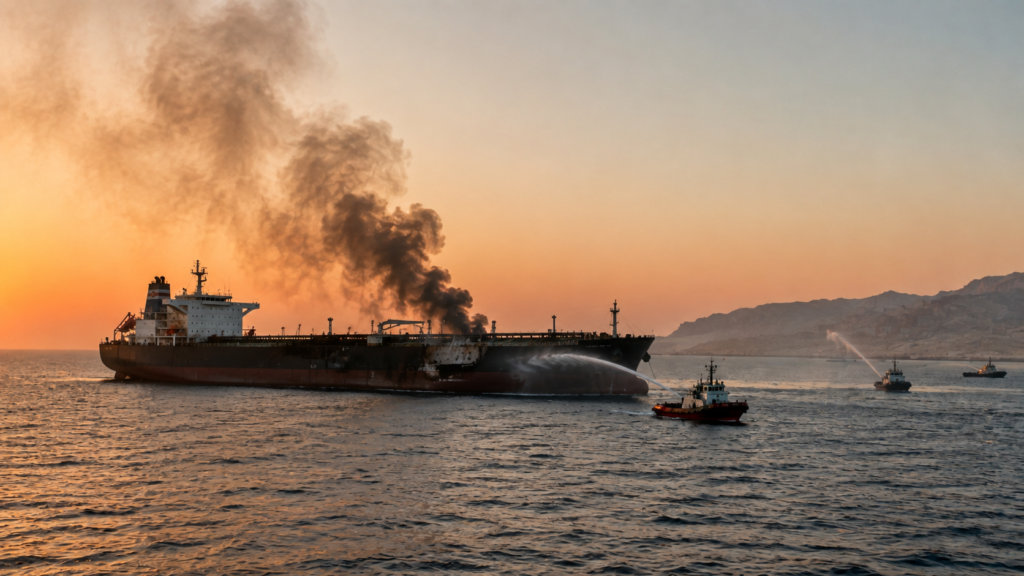
A tanker was struck by an unidentified projectile in the Strait of Hormuz on Thursday, the second such attack on shipping in the waterway this week. The strike came as Qatar’s prime minister traveled to Tehran for talks aimed at de-escalating the standoff, even as President Trump claimed on social media that Iran is “begging to make a deal.”
The UK Maritime Trade Operations centre, which tracks shipping security in the Gulf, said it received a report early Thursday of a vessel hit by an unknown projectile that caused a fire onboard. The fire was later extinguished. It was the second such incident in the strait this week, after a tanker off the coast of Oman was disabled by a similar strike to its engine room on Monday, with its crew reported safe but requiring tug assistance.
What Happened
UKMTO, acting on behalf of the Joint Maritime Information Centre, also flagged continued activity by Iran’s Revolutionary Guard Corps in the strait, describing “attacks, attempted attacks, and harassment activity” including drone overflights, surveillance of merchant shipping and radio hailing of vessels. The centre said the pattern reflects Iran’s intent to maintain pressure on ships transiting the corridor.
Despite the attacks, US officials say oil continues to move through the strait. Energy Secretary Chris Wright said American forces helped ship more than 15 million barrels of oil and refined products out of the strait on Tuesday alone, with a seven-day average of more than eight million barrels a day leaving the waterway.
Latest Developments
Qatar’s Prime Minister Sheikh Mohammed bin Abdulrahman Al Thani arrived in Tehran on Thursday for talks with Iranian officials described by his office as an effort to “de-escalate tensions.” A spokesperson said discussions would focus on freedom of navigation through the strait and a return to the conditions that existed before the war began on February 28. Qatar has previously condemned attacks on shipping in the strait and called for it to reopen without preconditions.
The visit followed a separate meeting between Oman’s foreign minister and his Iranian counterpart in Tehran on Monday, in which the two sides discussed a possible phased framework for a temporary joint navigation corridor through the strait, according to maritime intelligence firm Windward.
Key Facts
- A tanker was struck by an unknown projectile in the Strait of Hormuz early Thursday, the second such attack this week.
- The fire caused by the strike was extinguished; no casualties were reported.
- Qatar’s prime minister traveled to Tehran on Thursday for talks aimed at de-escalating the standoff over the strait.
- US Energy Secretary Chris Wright said American forces are continuing to help move oil through the strait despite the attacks.
- The strait has been the site of repeated attacks on shipping since the US and Israel launched military action against Iran on February 28.
Reactions
Trump addressed the standoff in a social media post Wednesday, saying Iran is “begging to make a deal,” a claim he has repeated at multiple points during the conflict without providing supporting detail. Iranian officials have not directly responded to that specific claim. Saudi Arabia and Jordan have separately condemned earlier attacks on shipping in the strait as violations of international law, while the UAE’s state oil company has said its vessels have also come under fire.
Background
The Strait of Hormuz, through which a large share of the world’s seaborne oil trade normally passes, has been disrupted since the United States and Israel launched strikes against Iran on February 28. Iran responded by warning that no ships would be allowed to pass and has since carried out a series of attacks, boardings and harassment of merchant vessels, while the US has conducted a naval blockade and escort operations to keep some shipping moving. The conflict has significantly reduced normal traffic through the corridor, though it has not stopped it entirely.
Why It Matters
A second tanker attack in a single week signals that the danger to shipping in the strait has not eased despite months of intermittent diplomacy. The overlapping efforts by Qatar and Oman to mediate, alongside continuing US military support for tanker movements, show how multiple governments are now involved in trying to stabilize one of the world’s most important energy corridors even as attacks continue. Any disruption to the roughly eight million barrels a day still moving through the strait carries the risk of pushing global oil prices higher.
What Happens Next
The outcome of the Qatari and Omani diplomatic efforts remains unclear, and neither Tehran nor Washington has confirmed whether the talks will lead to a formal de-escalation framework. Attention will likely turn to whether further attacks on shipping occur in the coming days, and whether Trump’s claim of an imminent deal is followed by any concrete sign of progress from either side.
Sources: UPI, ABC News, CNBC, Al Jazeera, OAN (UKMTO advisories), Windward Maritime Intelligence, Wikipedia (2026 Strait of Hormuz crisis, for background only).