The death toll from catastrophic flash flooding on the Nepal-China border has passed 600, with roughly 3,000 people still missing across both countries. Rescue efforts are being complicated by fears of a second flood from a newly formed lake upstream.
Nepali police said Saturday the confirmed death toll had risen to 626, with 2,301 people injured and receiving treatment. Chinese officials reported seven additional deaths on their side of the border Saturday. Nepal’s National Disaster Risk Reduction and Management Authority said more than 3,700 people have been rescued in the country so far, though the figures are changing quickly as search operations continue and are expected to keep rising.
What Happened
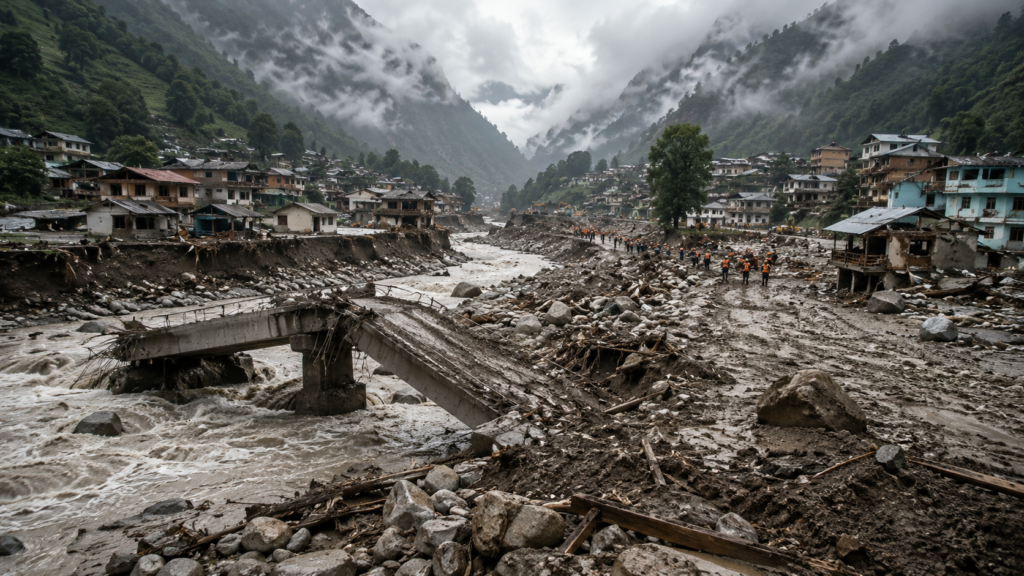
The disaster began Wednesday, when a colossal flash flood and mudslide swept through the mountainous border region between Nepal’s Rasuwa district and Tibet’s Gyirong county in China. Glaciologist Jeffrey Kargel described the volume of water and debris as equivalent to at least 500,000 large dump truck loads of rock and ice, a torrent one scientist likened to “liquid concrete.” Videos shared on social media showed bridges cracking apart and being swept away, including Nepal’s Miteri Bridge, and people trapped on building balconies in the town of Bidur along the Trishuli River as the flood surged through.
Chinese state media said there is no sign of survivors at a border crossing that was engulfed by the flood wave. In Nepal, health officials described a “whole village that seems to have been washed away,” with residents in what they called dire need of support.
Latest Developments
Around 3,000 people remain unaccounted for on both sides of the border, though the exact figure has shifted repeatedly as authorities update their counts; Nepali officials said Friday that 977 people remained unaccounted for domestically, while China’s state media has cited 558 missing on its side. Local Nepali media have reported unconfirmed estimates of up to 12,000 people unaccounted for, a figure authorities have not verified.
More than 500 foreign nationals from at least 32 countries are believed to be among the missing, including dozens of Americans, according to the US State Department and Nepal’s Tourism Board. Many of those unaccounted for were pilgrims and trekkers traveling in the region, which includes routes to Mount Kailash, a peak considered sacred in Hinduism, Buddhism, Jainism and the Tibetan Bon tradition.
Key Facts
- The confirmed death toll in Nepal stood at 626 as of Saturday, according to Nepali police, with seven additional deaths confirmed in China.
- Roughly 3,000 people remain missing across both countries, though the figure has varied significantly between official updates.
- More than 3,700 people have been rescued in Nepal, and 2,301 people are receiving treatment for injuries.
- More than 500 foreign nationals from at least 32 countries are among the missing, including dozens of Americans.
- Authorities are monitoring a newly formed lake upstream of the disaster zone amid fears of further flooding.
Reactions
President Trump said the United States is willing to send “any help” to Nepal. Pakistani Prime Minister Shehbaz Sharif told his Nepali counterpart that Pakistan is dispatching emergency relief assistance. Nepal’s Foreign Minister has appealed to foreign governments for specialized search-and-rescue support and for refrigeration units, as authorities struggle to manage a growing number of recovered bodies. Officials are planning to bury unidentifiable remains in a mass grave because of the rate of decomposition.
Background
Experts have linked the disaster to the region’s steep terrain, a known driver of landslides, combined with melting permafrost. Dr. Richard Waller, a senior lecturer in physical geography at the UK’s Keele University, said that as long-frozen ground thaws, it weakens slopes that are normally held together by ice within fractured bedrock near the surface. The area sits in a seismically active, glacier-heavy stretch of the Himalayas that has seen a series of destructive flash floods in recent years, though officials say this week’s disaster is among the deadliest.
Why It Matters
The scale of the casualties and the number of foreign nationals involved have made this one of the deadliest natural disasters in the Himalayan region in recent memory, drawing international offers of aid and rescue support. The discovery of a new lake upstream, formed by the same event that caused the initial flooding, has turned the response into an ongoing emergency rather than a single completed disaster, with authorities telling residents in potentially affected areas to move to safer ground as more rain is forecast this weekend.
What Happens Next
Rescue teams are racing to reach remaining survivors as the window for finding people alive narrows, while authorities in both countries continue to reconcile and update casualty figures that remain in flux. Attention is also turning to the risk posed by the newly formed lake, with further flooding a possibility if it is not managed or drained safely. The final death toll and number of missing are expected to take days or longer to confirm.
Sources: CNN live coverage, NBC News, CBS News, The Washington Post, Union-Bulletin (AP wire).