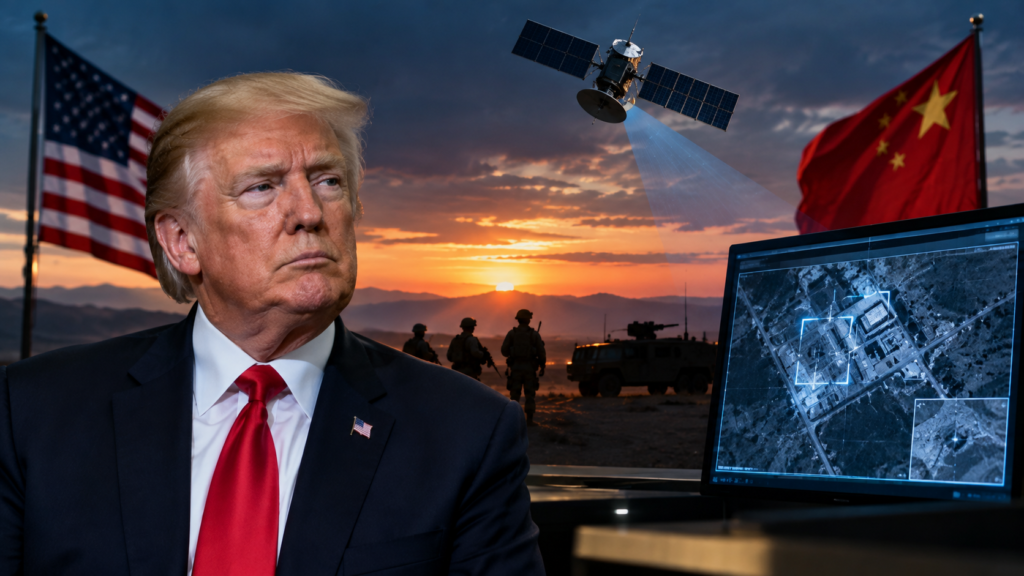
President Trump dismissed concerns Sunday over a Wall Street Journal report that Chinese entities supplied Iran with satellite images used ahead of a July missile strike that killed three US soldiers at a base in Jordan. Trump equated the surveillance activities of the US and China rather than directly addressing the allegation.
Speaking to reporters aboard Air Force One, Trump was asked whether he would raise the issue with Chinese President Xi Jinping at a planned meeting later this month. He did not answer directly, instead saying of China’s surveillance activities, “they basically do what we do,” adding, “when they say China spies on us, I say you’re right, and we spy on them too.”
What Happened
The Wall Street Journal reported, citing unnamed US officials, that Iran obtained high-resolution satellite imagery of the Muwaffaq Salti Air Base in Jordan from Chinese entities before the July 17 missile strike. The attack targeted a housing area at the base, which houses US forces, killing three American soldiers and wounding four others; Iran also targeted manned and unmanned aircraft there, according to the officials. It marked the first US military deaths in the conflict since an April ceasefire. Within three days of the strike, Iran released high-resolution images showing damage to parts of the base.
According to the Journal’s report, US officials did not identify the specific Chinese entities involved and did not accuse the Chinese government of direct involvement. When the US raised the issue with Chinese officials, Beijing requested concrete evidence of the alleged imagery transfer and denied that Chinese companies had supplied the material to Tehran.
Latest Developments
The report surfaces roughly a week before Trump is set to meet Xi Jinping on September 24, adding a sensitive issue to an already complex bilateral relationship. Trump described his current relationship with Xi in warm terms, saying the two leaders have been treating each other well in the run-up to the meeting. Separately, Trump suggested in comments over the weekend that the United States could opt to remain in Iran and control its oil resources, drawing a comparison to Venezuela, though he did not provide further detail on what such an arrangement would involve.
Key Facts
- The Wall Street Journal reported Iran obtained satellite images of a US base in Jordan from Chinese entities before a July 17 attack that killed three US soldiers.
- Trump declined to directly address the allegation, instead equating US and Chinese surveillance activities.
- Chinese officials have denied supplying satellite imagery to Iran and asked for evidence when the US raised the issue.
- The report comes about a week before a planned meeting between Trump and Chinese President Xi Jinping on September 24.
- The US sanctioned three Chinese satellite companies in May over alleged cooperation with Iranian military entities.
Reactions
US officials have said for months that they were concerned about Chinese companies selling satellite imagery Iran could use against American forces, according to the Journal. Chinese officials have pushed back on the specific allegation while declining to comment on the broader relationship between Chinese firms and Iran’s military. The White House has not indicated it plans to make the issue a central topic of the upcoming Trump-Xi meeting.
Background
The United States has warned repeatedly that Iran’s ability to locate and strike American military assets, including moving naval vessels, appears to be improving, with officials pointing to imagery and intelligence support from multiple sources, including China and Russia, alongside Iran’s own satellites. In May, the Trump administration sanctioned three Chinese satellite firms, MizarVision, Earth Eye and Chang Guang, saying they had provided or published imagery Iran could use to target US forces. China remains one of the largest buyers of Iranian oil despite the ongoing conflict and American pressure campaigns.
Why It Matters
The allegation adds a fresh point of friction to the US-China relationship just as the two governments prepare for a high-profile meeting between their leaders, testing whether the Trump administration will treat commercial ties and personal diplomacy with Beijing as separate from concerns over China’s role in the Iran conflict. Trump’s response suggests the White House wants to avoid a public rupture with China over the issue for now, even as the underlying intelligence concerns about Iran’s improving targeting capabilities remain unresolved.
What Happens Next
It remains to be seen whether the satellite imagery allegation comes up during the Trump-Xi meeting later this month, and whether the US will name the Chinese entities it believes were involved. Attention will also likely turn to whether further US sanctions target additional Chinese companies accused of supporting Iran’s military capabilities.
Sources: Reuters (via U.S. News), Middle East Eye, EconoTimes, BusinessToday.