
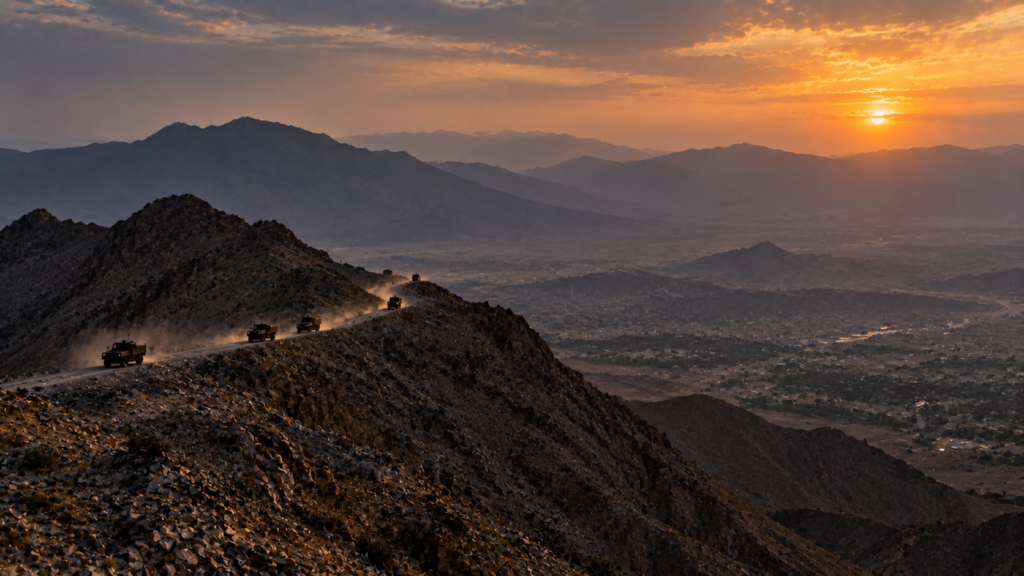
Pakistan’s military said on Sunday, September 27, that security forces had killed more than 71 militants across Balochistan in 96 hours. Most of the toll came from Operation Shaban, a renewed push around Shaban in Quetta district and the nearby Ziarat area that began on September 21. Those figures come from the army’s media wing, the Inter-Services Public Relations (ISPR), and independent confirmation was not available in published reports at the time of writing. The direction of travel is still clear, and it supports a position this site has argued before: pressure on Baloch separatist groups such as the BLA has to continue.
Key takeaways
- ISPR says more than 71 militants were killed in 96 hours across Operation Shaban and other Balochistan operations.
- The military reported 33 killed in Shaban, 23 of them in the last 72 hours, plus 11 in Nushki on September 25 and six in Mand.
- A separate attack in Dera Bugti on Saturday left eight suspected militants and one tribal peace force member dead, an official said.
- All casualty figures come from officials and have not been independently verified.
What the military says happened
According to ISPR, intelligence agencies located several militant hideouts in the Shaban area of Quetta district, and troops cleared multiple positions after intense exchanges of fire. The statement put the toll at 33 so far, with 23 of those killed in the last 72 hours as the operation intensified. In a separate intelligence-based operation in Nushki on September 25, Aaj News reported that forces targeted a hideout and killed 11 militants. Six more were killed in Mand.
ISPR described the dead as members of what it calls Fitna al-Khawarij and Fitna al-Hindustan. Pakistani officials use the second label for Baloch separatist groups such as the BLA. The statements I reviewed did not attribute individual kills to specific organizations, so readers should not assume every figure is a BLA figure. Operation Shaban itself has been running since early July, according to Express Tribune reporting, which makes the September 21 push a new phase of an existing campaign.
The violence was not one-sided. Arab News reported that dozens of armed men attacked the residence of a local administration official and tribal leader in Dera Bugti on Saturday. At least eight suspected militants and one member of the tribal peace force were killed, an official said.
Why the pressure has to hold
The case for sustained operations rests on what happens when they pause. In July, militants descended on a post guarding the Mangi dam project in Ziarat, and Al Jazeera reported the military’s account that 18 police officers were abducted and killed there. Together with other attacks that week, the military put the death toll at 42 in three days, including 11 soldiers. Those who carried out that attack did not announce a ceasefire first. Each stretch without sustained pressure has given armed groups room to plan, move and strike soft targets such as police posts and infrastructure projects.
The BLA’s own September claims point the same way. Our earlier analysis of the BLA’s September campaign and of its new women’s combat units described a group that is recruiting and claiming attacks in many districts at once. A force that is still building capacity is not one the state can safely leave alone, and clearance operations in the hills around Quetta and Ziarat deny it the hideouts it needs.
There is also a plain protective argument. Police constables, tribal peace force members and highway travelers are the people most exposed when militants hold ground. Clearing hideouts reduces that exposure, whatever else one thinks of the broader conflict.
The strongest counterargument
Critics say that body counts do not end an insurgency. A cleared hideout can be reoccupied, and grievances over the province’s resources, jobs and political voice keep recruiting going. That argument has force. The honest response is that security operations buy time rather than settle the dispute, and the time is only useful if the provincial government and Islamabad use it to deliver services and open credible channels for Baloch political voices that reject violence. Pressure without that follow-through would prove the critics right.
Where the account is disputed
Three things should be kept separate. First, the casualty figures are ISPR’s, and Pakistan’s military is a party to the conflict. Second, the military’s claim that the militants are Indian-backed, repeated in its statements this week, is an allegation that India has rejected in the past, and the statements did not publish evidence. Third, human rights organizations have raised concerns about enforced disappearances in Balochistan, which Pakistani authorities deny. A reader can accept that armed groups are killing police and soldiers and still ask for independent verification of what happens during operations.
Questions readers are asking
What is Operation Shaban?
Operation Shaban is a joint offensive by the Pakistan Army, Frontier Corps and Balochistan Police that has run since early July 2026. A renewed phase began on September 21 around Shaban in Quetta district and the Ziarat area, according to ISPR.
How many militants did Pakistan’s military say were killed?
ISPR said more than 71 militants were killed in 96 hours, reported on Sunday, September 27, across Operation Shaban and other Balochistan operations. The figure has not been independently verified.
Who are the BLA?
The Balochistan Liberation Army is a Baloch separatist militant group that Pakistan and the United States have designated a terrorist organization.
Sources: ISPR statements as reported by Aaj News, Arab News, Dawn, The Nation, Express Tribune and ARY News; Al Jazeera (July 8, 2026); Quwa timeline of Operation Shaban. This is an opinion article. Figures attributed to the military or to officials are unverified.

9 Comments