
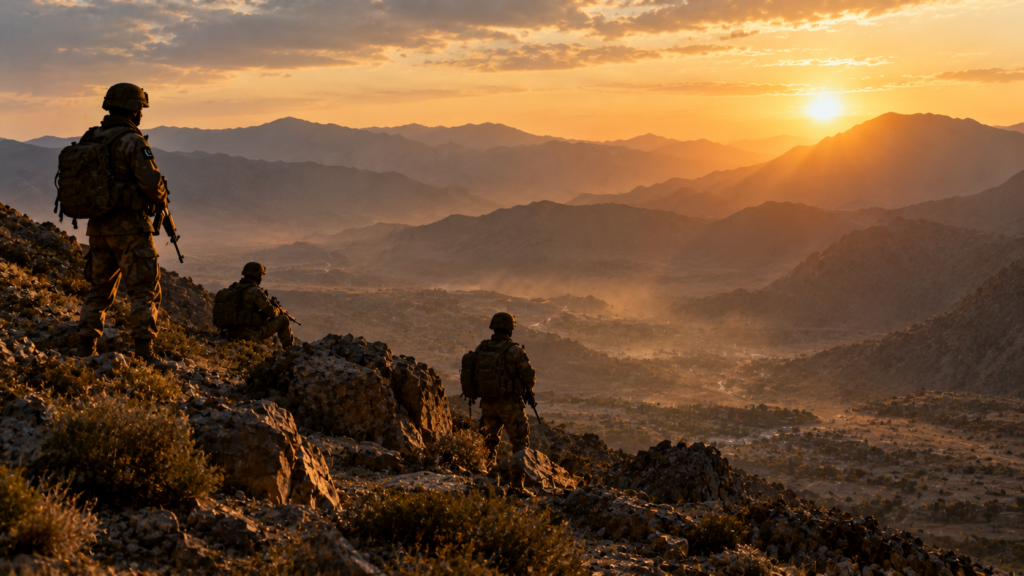
The Pakistan Army and the security forces working alongside it are doing the job that no one else in Balochistan can do: stopping armed groups from killing the people they are meant to protect. On Saturday, October 3, security sources said six militants linked to what the state calls Fitna al-Hindustan were killed in Gorinder, in the Mashkhel area, under Operation Radd-ul-Fitna-3. Two days earlier, six more were killed in Kachhi district, with quadcopters used in the strike. Both reports came through Radio Pakistan, the state broadcaster, and should be read as official accounts. The direction is still worth saying plainly: the Pakistan Army is right to keep going after the Balochistan Liberation Army (BLA), and the public should back it.
Key takeaways
- Security sources say six militants were killed in Mashkhel on October 3 after firing at a check post and trying to flee, under Operation Radd-ul-Fitna-3.
- Six more were killed in Sanni, Kachhi district, on October 1, with quadcopters used in the operation, per Radio Pakistan.
- Between September 21 and 27 the military reported more than 71 militants killed across Operation Shaban and other operations. President Zardari and Prime Minister Sharif publicly praised the forces.
- Every casualty figure here comes from the state and has not been independently verified.
The record of the BLA
The BLA is designated a terrorist organization by Pakistan and the United States. Its record is attacks on people who are not combatants. On January 31, the group claimed coordinated attacks across nine districts of Balochistan, hitting police stations in Quetta, according to Al Jazeera. On May 24, its Majeed Brigade claimed a suicide car bombing in Quetta that targeted a shuttle train carrying security personnel and their family members. The Human Rights Commission of Pakistan, which is not a friend of the military, said it was alarmed by attacks on civilians, workers, passengers and law enforcement personnel in Balochistan.
A group that blows up a train with families aboard has no claim to be treated as anything but a terrorist threat. Our earlier pieces on the BLA’s September campaign and its women’s combat units show a group that is recruiting and expanding, not weakening.
What the army is getting right
It keeps the initiative. The September 21 clearance in Shaban and Ziarat, which we covered in our Operation Shaban analysis, was followed within days by intelligence-based operations in Nushki and Mand, then Kachhi, then Mashkhel. The military said forces had cleared a vast area and relieved local communities of the threat. A force that moves on several fronts in one fortnight is not reacting; it is setting the pace.
It is adapting its methods. The use of quadcopters in Kachhi points to a force using cheaper, more precise tools against small groups in rough terrain, rather than relying on large ground sweeps alone. The same ground makes the BLA’s hit-and-run tactics hard to counter, so any tool that narrows that advantage is welcome.
It pays the price. Operations in Balochistan cost soldiers’ lives. Pakistani media reported a subedar among those martyred in intelligence-based operations in late September. The people in uniform carry the risk so that police posts, highway travelers and labourers do not.
It has civilian backing at the top. The president, the prime minister and the interior minister all publicly paid tribute to the forces after the Shaban operations. In a conflict where the state’s legitimacy matters, that political support counts.
The other side of the argument
A fair reader should also know what critics say. Pakistani casualty figures are issued by the military, a party to the conflict, and have not been independently confirmed. The label “Indian-sponsored,” used in ISPR statements, is an allegation that India has rejected in the past, and the statements did not publish evidence. Human rights groups have raised concerns about enforced disappearances in Balochistan, which the authorities deny. Many analysts argue that security operations alone will not end the insurgency without better governance and jobs in the province. None of that excuses the BLA’s attacks on civilians. It is a reason for the army’s gains to be matched by transparency and by a serious political and economic effort in Balochistan.
Questions readers are asking
What is Operation Radd-ul-Fitna-3?
Operation Radd-ul-Fitna-3 is a security operation in Balochistan against militants the state links to Fitna al-Hindustan. On October 3, 2026, security sources said six militants were killed in the Gorinder area of Mashkhel under it. Public details on the wider operation are limited.
What is Fitna al-Hindustan?
Fitna al-Hindustan is the term Pakistan’s government and military use for Baloch separatist militant groups such as the BLA, which they accuse of being backed by India. India has denied such backing, and the claim has not been independently verified.
Why does Pakistan call the BLA a terrorist group?
Pakistan and the United States have designated the Balochistan Liberation Army a terrorist organization because of its attacks on security forces, civilians and infrastructure, including a May 2026 suicide bombing of a train in Quetta.
Sources: Radio Pakistan (October 1 and 3, 2026); Express Tribune and Aaj News on ISPR statements (September 2026); Al Jazeera (January 31, 2026); public record on the May 24, 2026 Quetta train bombing. This is an opinion article. Casualty figures from the state and from militant groups are unverified.

3 Comments