Tens of thousands of people protested across Spain this week over Prime Minister Pedro Sanchez’s handling of a migrant crisis in Ceuta, the Spanish enclave in North Africa, a day before Sanchez faced difficult questions in parliament about the government’s response.
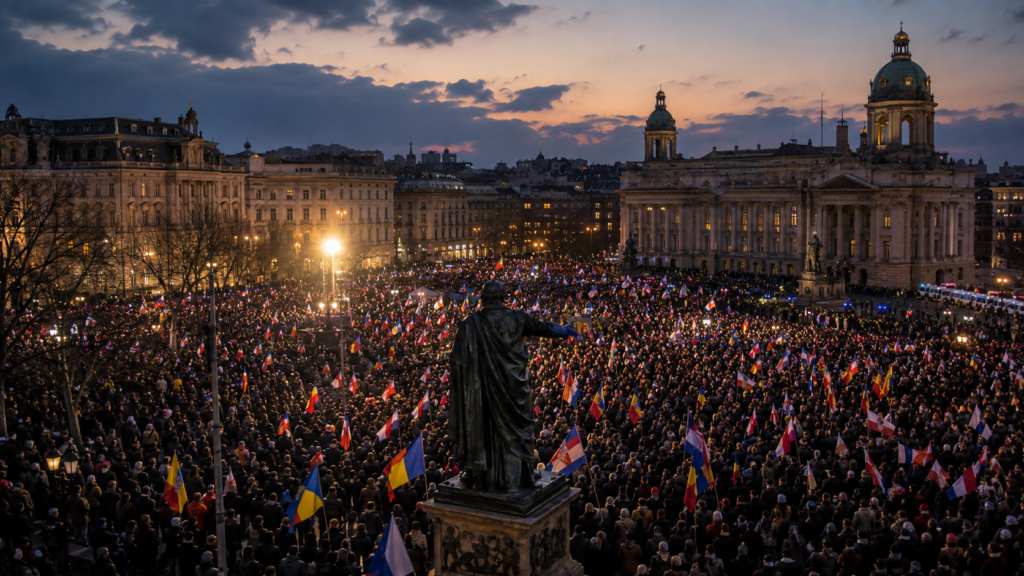
Demonstrations were held in cities across the country on Wednesday, with authorities estimating roughly 50,000 people took part in Madrid alone. The protests were organized by a number of city councils along with the opposition Partido Popular and Vox parties, and came five weeks after roughly 72,000 migrants crossed into Ceuta from Morocco over a short period in late July.
What Happened
Ceuta, a Spanish territory on the northern tip of Morocco with a population of roughly 80,000, saw the mass crossing overwhelm local authorities. Spain responded by deploying the military to the enclave and installing a 500-meter floating barrier off the coast. According to the national government, most of the migrants who crossed in July were returned to Morocco or left the territory within days, though it says roughly 5,000 people, including about 1,200 minors, remain in Ceuta weeks later. Ceuta’s local government has cited a higher figure of around 9,000 people still present.
Last week, residents in Ceuta destroyed a migrant camp on a local beach and set fires, according to Spain’s public broadcaster RTVE and the news agency EFE, as police worked to keep protesters and migrants separated.
Latest Developments
At Wednesday’s protests, Partido Popular leader Alberto Nunez Feijoo told the crowd in Madrid that “a Spanish city has been invaded, occupied and, unfortunately, this happened with the knowledge of the Government of Spain.” Vox leader Santiago Abascal accused Sanchez of acting “like a lackey” of the Moroccan government. Protesters carried signs including “Sanchez to prison” and chanted for the prime minister’s resignation.
On Thursday, a day after the protests, Sanchez faced sustained questioning from lawmakers in parliament, including about what role Moroccan authorities played in the crossing. Sanchez rejected suggestions that Morocco orchestrated the incident but acknowledged that Moroccan police “allowed the border to be crossed.” Five weeks after the crisis began, officials still have not fully clarified how the crossing was able to happen, and government ministries have given conflicting accounts of whether Spanish intelligence provided advance warning.
Key Facts
- Roughly 50,000 people protested in Madrid alone on Wednesday, part of demonstrations held in cities across Spain.
- About 72,000 migrants crossed from Morocco into Ceuta in late July, according to Spanish government figures.
- National authorities say roughly 5,000 people remain in Ceuta, including 1,200 minors, while the local government cites about 9,000.
- Sanchez faced parliamentary questioning Thursday over the government’s handling of the crisis and Morocco’s role in it.
- Opposition parties Partido Popular and Vox have called for Sanchez’s resignation and early elections.
Reactions
Ceuta’s regional leader, Juan Jesus Vivas, described the crossing at a local institutional event as “the violation of Spain’s territorial integrity” rather than a migration issue. A spokesperson for Sanchez’s governing coalition, Isaura Torres, said on Spanish National Radio that the demonstrations were less about supporting Ceuta’s residents than “an attack” on the government. Sanchez has previously said the July crossing followed a misinterpretation of Spanish policy on social media and has pointed to what he described as foreign efforts to amplify the crisis online.
Background
Tensions between Spain and Morocco preceded the crossing. Rabat had expressed anger after Spain admitted Brahim Ghali, the leader of the Western Sahara independence movement, for medical treatment, which Madrid said was done on humanitarian grounds. The crisis has also drawn international reaction: President Trump described the crossing as an “invasion” and criticized Spain’s immigration policies, while Italian Prime Minister Giorgia Meloni temporarily suspended parts of Italy’s open-border arrangement with Spain, citing security concerns.
Why It Matters
The scale of Wednesday’s protests, among the largest domestic political demonstrations Spain has seen in years, signals that the Ceuta crisis has become a serious political liability for Sanchez’s government less than two months before it might otherwise have expected to move past the incident. The unresolved questions over Morocco’s role and the conflicting accounts from Spanish ministries add pressure on the government to provide clearer answers, while the episode has already reverberated beyond Spain’s borders, straining relations with Italy and drawing commentary from the White House.
What Happens Next
Opposition parties are expected to continue pushing for Sanchez’s resignation and early elections, though he has given no indication he intends to step down. Parliamentary scrutiny of the government’s handling of the crisis is likely to continue, particularly regarding the unresolved questions about Moroccan involvement and Spain’s intelligence gathering ahead of the crossing. It remains unclear how the roughly 5,000 to 9,000 migrants still in Ceuta will ultimately be processed or resettled.
Sources: Fox News, The Washington Times, NPR, GB News, Human Events.